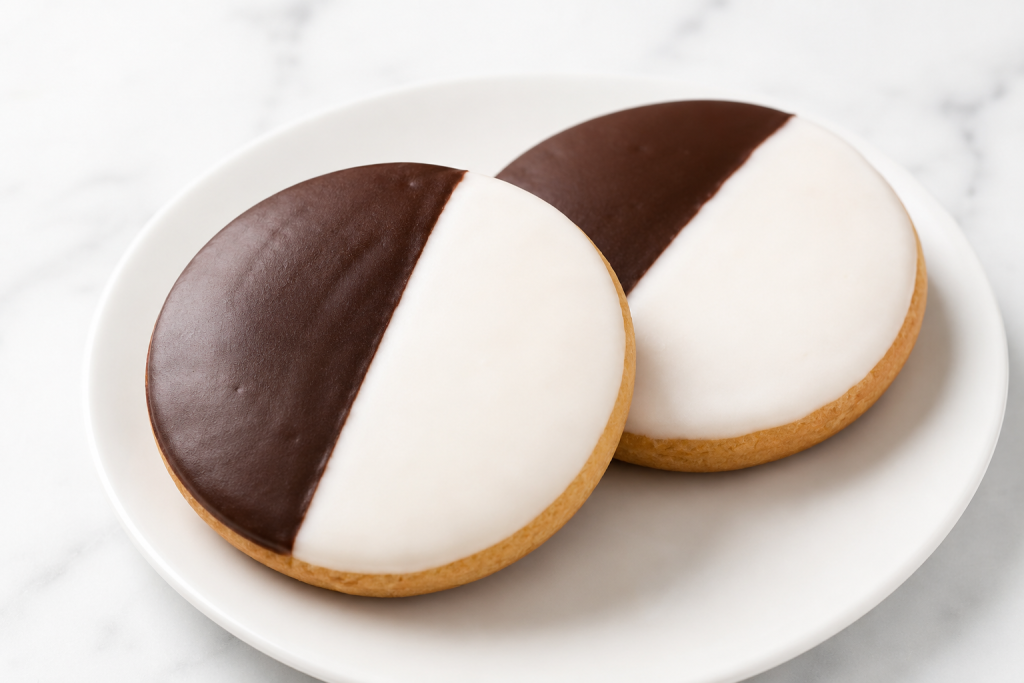
Walk into any German bakery, or Bäckerei, and you’ll likely see them: soft, cake-like cookies, flat on the bottom and slightly domed on top, covered in a distinctive half-black, half-white glaze. These are Amerikaner, a pastry that, despite its name, is thoroughly German. But how did this cookie get its name, and why does it look so familiar to Americans?
A Cookie with a Confusing Name
The most common story traces the name back to the post-WWII era when American soldiers were stationed in Germany. The cookies were supposedly made by German bakers using ingredients provided by the US Army, leading to the name “Amerikaner” as a tribute. Another theory suggests the name comes from the ammonium bicarbonate used as a leavening agent, which in German is “Ammoniumhydrogencarbonat”- a bit of a mouthful, so “Amerikaner” might have been a convenient shorthand.
One popular myth to get out of the way- the name has nothing to do with President John F. Kennedy’s famous “Ich bin ein Berliner” speech. While it’s a fun story to connect the two “pastry incidents,” the cookies were around long before his 1963 visit.
What Makes an Amerikaner an Amerikaner?
Unlike the American black-and-white cookie, which is often a flat, shortbread-style cookie, the German Amerikaner is much lighter and fluffier. The dough is closer to a thick cake batter, often made with buttermilk and leavened with baking powder or ammonium bicarbonate (Hartshorn). This gives it a soft, airy texture that melts in your mouth.
The iconic glaze is a simple sugar icing. Half is left white, while the other half is mixed with cocoa powder to create the black side. The flavor is simple, sweet, and satisfying- a perfect companion to a cup of coffee or a glass of milk. It’s a taste of childhood for many Germans.
Finding Amerikaner in America
While not as common as pretzels or Black Forest cake, you can still find authentic Amerikaner in the United States, especially in cities with strong German heritage. Look for dedicated German bakeries in places like Milwaukee, Wisconsin; Cincinnati, Ohio; or Fredericksburg, Texas. They are often hiding in plain sight on the pastry tray.
If you don’t have a German bakery nearby, they are also surprisingly easy to make at home. The ingredients are simple, and the process is straightforward, making it a great baking project for a lazy weekend afternoon. It’s a wonderful way to bring a little piece of German bakery culture right into your own kitchen.
Have you ever tried an Amerikaner cookie? Or do you have a favorite German bakery in your city that makes them? Let us know in the comments below!